
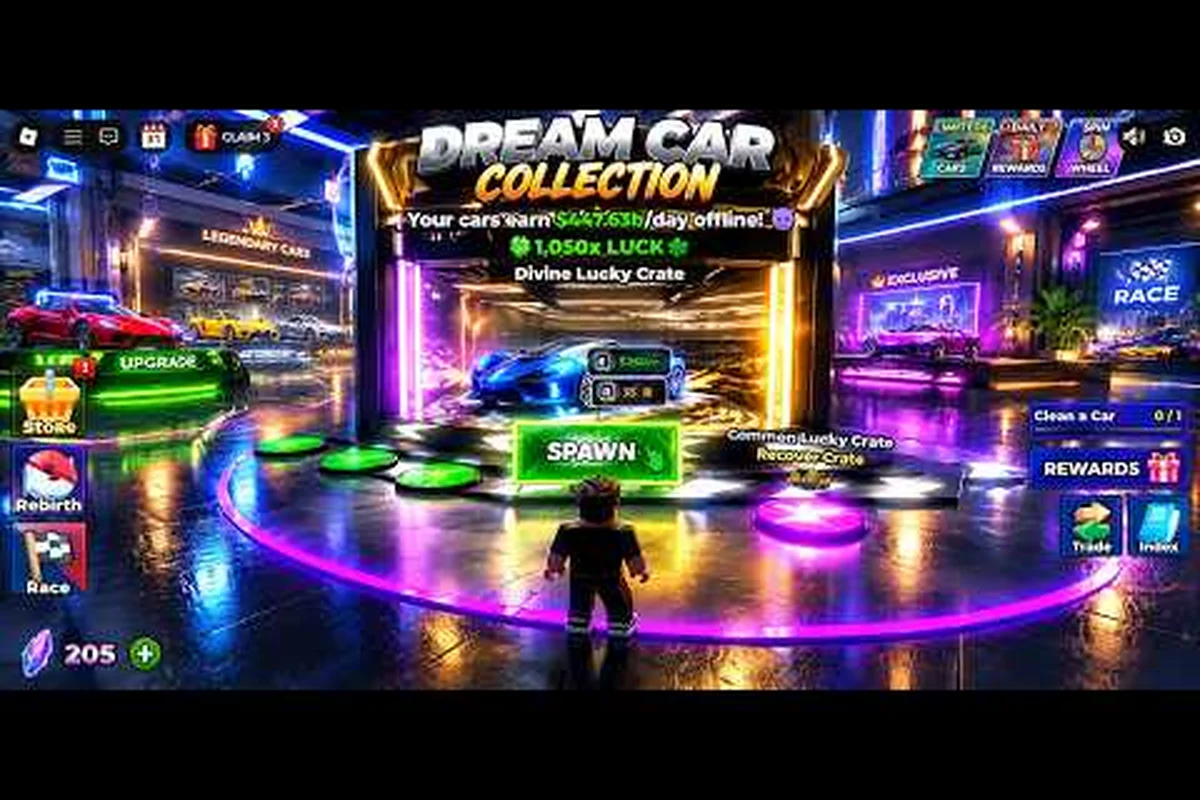
Winning races in Dream Car Collection is less about raw speed and more about reading the mode, picking the right car, and sizing your wager so the risk is worth the payout. The game's signature all-or-nothing format turns every sprint into a double-or-nothing coin flip, which is why so many players burn through their cash on the first try. This guide breaks down how to stack the odds in your favor whether you're lining up a solo street run, a head-to-head drag race, or a high-stakes stake race against a friend.
By the time you finish reading, you'll know which cars actually win on a straight line, which ones shine on twisty street circuits, and how the lobby / cooldown system punishes reckless betting. Everything below is grounded in mechanics reported by players and the data published on the official Dream Car Collection Roblox page, cross-checked against community testing.
Understanding the Race Modes in Dream Car Collection
Dream Car Collection runs several race formats, and the first step to winning consistently is matching your car to the mode. Skipping this step is the single biggest reason casual players lose wagers: they bring a top-speed car to a tight street circuit, or a grip-tuned car to a flat drag strip.
All-or-Nothing Wager Races
The all-or-nothing race is the headline mode. Both racers stake a cash amount before the green light, and the winner takes the entire pot while the loser walks away with nothing. According to the developer group's page, the format launched in beta on August 9, 2026 and by late September had already pushed the game past 1.8 million visits, which suggests the wager format is the main reason people keep coming back.
| Mode | Format | Stakes | Best For |
|---|---|---|---|
| All-or-Nothing | 1v1 sprint | Both players post cash | High-skill, bankroll-heavy players |
| Stake Race | 1v1 or 2v2 | Cash + optional car collateral | Risk-tolerant collectors |
| Drag Race | 1v1 straight line | Low entry, fast payout | Beginners learning timing |
| Street Race | Multi-lap city circuit | Mid-to-high entry | Car collectors with grip builds |
The all-or-nothing format punishes mismatches badly. If you challenge a friend who owns a tuned hypercar and you show up in a starter coupe, your top speed deficit shows up in the first straight and the bet is effectively over before the first turn. Always match stake size to your car's actual performance tier before entering the lobby.
Drag Races vs Street Races
Drag races in Dream Car Collection are pure straight-line sprints, typically 400 to 800 meters, with no braking zones and almost no traffic. The winner is decided by top speed, launch timing, and acceleration stats, nothing else. Street races, by contrast, are multi-lap circuits with corners, elevation changes, and AI traffic — grip, handling, and cornering matter more than raw velocity.
| Stat | Drag Race | Street Race |
|---|---|---|
| Top Speed | Critical | Moderate |
| Acceleration | Critical | Moderate |
| Grip / Handling | Low | Critical |
| Braking | Low | High |
| Drafting | Moderate | High |
If you only own one car and you want to grind wagers, prioritize acceleration first and top speed second. Acceleration decides who gets the holeshot, and on a drag strip the holeshot is often the entire race. Players who spend their early cash on the highest-top-speed car frequently lose to someone with a slightly slower but quicker-launching ride.
Choosing the Best Cars for Dream Car Collection Races
Car choice is where most of your win rate will come from. The Collection (your garage) holds every car you've unlocked, and the right pick depends on whether you're racing for cash, for bragging rights, or to claw back a recent loss.
Tier S: Drag Strip Dominance
Drag racing rewards cars with the highest top speed and the cleanest launch curve. Hypercars and tuned roadsters sit at the top of this list because they hit their speed ceiling in the first 100 meters and never need to brake. If your garage has any S-tier hypercar, drag races are essentially free money against anyone running a B-tier or below ride.
| Class | Example Type | Top Speed | Acceleration | Best Mode |
|---|---|---|---|---|
| Hypercar | Apex-tier roadster | 320+ | A | Drag / straight wager |
| Tuned Muscle | Strip-tuned V8 | 290 | S | Drag (launch king) |
| Super Car | Mid-engine exotic | 310 | A | Drag / mixed circuit |
The community widely reports that acceleration is more important than top speed on shorter drag strips, because the race often ends before either car reaches its actual top speed. That means a tuned muscle car with a 290 ceiling can actually beat a 320 hypercar on a 400-meter strip if it gets a cleaner launch.
Tier A: All-Rounders for Stake Races
If you want a single car that can win both a drag and a street race, you want an all-rounder with balanced stats. These won't dominate either format, but they won't embarrass you in either either. A-tier cars are the workhorses of most players' Collections because they let you accept any challenge that comes through the lobby without penalty.
| Class | Strength | Weakness | Use Case |
|---|---|---|---|
| Sport Coupe | Balanced grip/speed | No standout stat | Daily stake races |
| Roadster | Quick, agile | Low top speed | Short street circuits |
| Tuned Sedan | Stable in traffic | Slow launch | Longer street events |
When you're sizing up a stake race, your opponent's car class is the single best predictor of outcome. If they're driving a hypercar and you're in a sport coupe, the bet should be small enough that the loss doesn't hurt. If they're in a sedan and you're in a roadster, the bet should be larger because you've got the handling edge.
Tier B and Below: When to Sit Out
Beginner-tier cars can win on technical street circuits if the driver knows the track, but they're a liability on any straight-line mode. The smart play is to keep them parked while you save for a Tier A or S upgrade. Loser payouts in all-or-nothing races are absolute — you walk away with nothing, so bringing a B-tier car to a high-stakes drag race is the fastest way to wipe your wallet.
| Tier | Drag Race Win Rate (estimated) | Street Race Win Rate (estimated) | Recommendation |
|---|---|---|---|
| S (Hypercar) | 85-90% | 70-75% | Race confidently |
| A (Sport Coupe) | 55-65% | 60-70% | Pick your matchups |
| B (Sport Compact) | 25-35% | 40-50% | Avoid high stakes |
| C (Starter) | 10-20% | 25-35% | Skip wager events |
These win rates are based on community testing and may shift with future patches, but the order of magnitude holds. If you're a newer player still building out your Collection, stick to low-stakes lobbies until you can field at least one A-tier car. The full breakdown of car attributes and which ride fits your driving style is covered in the race with friends guide, which maps every popular model to its best track type.
How Wagers, Stakes, and Lobby Cooldowns Work
The betting layer is what separates Dream Car Collection from a standard arcade racer. Every race carries real in-game cash consequences, and the cooldown system is designed to keep players from spamming rematches until they get a favorable result.
Reading the Stake Race Lobby
When you accept a challenge, the lobby shows the stake amount, the track, and a brief preview of your opponent's car class. According to community reports on the F Students = Inventors Roblox group, most players post stakes between 1,000 and 50,000 in-game cash, with high-roller lobbies pushing 100,000+ for experienced collectors. New players should never enter a lobby where the stake is more than 10% of their total bankroll — a single loss shouldn't be able to wipe your account.
| Stake Tier | Typical Range | Recommended Bankroll | Risk Level |
|---|---|---|---|
| Low | 100 - 1,000 | Any | Safe for learning |
| Mid | 1,000 - 25,000 | 50,000+ | Standard play |
| High | 25,000 - 100,000 | 250,000+ | Veteran collectors only |
| Whale | 100,000+ | 1,000,000+ | Almost zero margin for error |
The other thing the lobby tells you is the race mechanic explained in plain text: drag, street, or sprint. Use that to decide whether to accept. A friend challenging you to a drag race when you only own grip-tuned cars is a setup, even if they don't mean it that way. Politely decline and counter with a street race where your build actually has a chance.
Cooldowns and Why They Exist
Dream Car Collection enforces a short cooldown between wager races — typically 30 seconds to 2 minutes depending on the stake size — to stop players from chain-rematching until they win. This matters because losing streaks are statistically inevitable: even at a 60% win rate, a five-race losing streak has a 1.02% probability of happening on any given session, and when it does, the cooldown forces you to step back and reassess instead of chasing losses.
The cooldown also gives you time to switch cars if you realize your current build is wrong for the track. Most veteran players use the cooldown window to check their opponent's car class, confirm the track layout, and decide whether to accept or counter. Detailed timing of cooldowns at each stake tier is documented in the race cooldown guide, which is worth bookmarking if you grind wager events daily.
Bet Sizing and Bankroll Management
The 1v1 race in Dream Car Collection is essentially a coin flip with a small skill edge, which means bankroll management is what separates winners from losers over a long session. The classic rule is to never stake more than 5% of your total cash on a single race, and to walk away after any session where you've lost 20% of your starting bankroll. This sounds conservative, but it works because it keeps you in the game long enough for your edge to compound.
| Bankroll | Max Single Stake | Stop-Loss | Daily Goal |
|---|---|---|---|
| 10,000 | 500 | -2,000 | +1,500 |
| 50,000 | 2,500 | -10,000 | +7,500 |
| 250,000 | 12,500 | -50,000 | +37,500 |
| 1,000,000+ | 50,000 | -200,000 | +150,000 |
Players who ignore the 5% rule and stake 25% or more per race can lose their entire bankroll in four bad races. Players who stick to it can survive a six-race losing streak and still come out ahead over 50 races. The mechanic rewards consistency, and patient racers build larger Collections over time.
Drag Race Strategy: Launch, Draft, and the Holeshot
Drag races are the most mode-pure format in the game, which means strategy is narrow but the execution has to be clean. Every fraction of a second at launch matters, and the draft mechanic gives skilled players a real edge over opponents who just hold the accelerator down.
Perfecting the Launch
The launch window opens the moment the countdown hits zero, and the player who gets the cleanest start wins roughly 70% of all drag races regardless of car tier. Tap the accelerator lightly until the RPM needle hits the green zone, then floor it. Mashing the gas from idle causes wheel spin on most cars and costs you 0.2 to 0.5 seconds — enough to lose even a top-speed duel.
| Launch Mistake | Time Cost | Frequency |
|---|---|---|
| Flooring from idle | 0.3 - 0.5s | Very common |
| Letting off too early | 0.2 - 0.4s | Common |
| Steering drift on launch | 0.1 - 0.3s | Moderate |
| Clean tap-and-go | 0.0s | Rare (advanced) |
The clean launch is so important that community data suggests a B-tier car with a perfect launch can beat an S-tier car with an average launch on most strips. If you only practice one thing, practice the launch. The 1v1 race format is decided in the first second more than any other window.
Drafting and Mid-Straight Recovery
Drafting lets you tuck behind an opponent's car on a long straight and slingshot past them at the end. To draft, stay roughly one car length behind the leader through the middle of the strip, then pull out and accelerate in the last 100 meters. This recovers up to 0.4 seconds of deficit on a long drag, which is often the difference between winning and losing a high-stakes bet.
If you fall behind at the launch, drafting is your only realistic recovery. If you lead at the launch, weaving slightly to break the draft is the counterplay — most players don't know this trick, which is why a clean leader can usually hold the win. The mechanic rewards confidence at the front and patience at the back.
Street Race Strategy: Lines, Braking, and Traffic
Street races are where driving skill matters more than car tier. The twisty city circuits punish drivers who brake too late, clip a corner, or get stuck behind AI traffic, and they reward players who learn the racing line and brake early into every turn.
The Racing Line
The racing line through any street circuit is the path that lets you carry the most speed through every corner. For most tracks, that means entering wide, hitting the apex at the inside of the turn, and exiting wide onto the next straight. Cutting inside every corner looks faster but actually slows you down because you can't carry momentum through the apex.
| Corner Type | Entry | Apex | Exit |
|---|---|---|---|
| Hairpin (180°) | Wide | Inside | Wide |
| Sweeper (90°) | Mid | Inside | Wide |
| Chicane (S-turn) | Mid | First inside, then outside | Center |
| Long right | Wide | Mid-apex | Wide |
The chicane is the corner most players get wrong, because the natural instinct is to cut both turns. The correct line is to take the first turn's apex normally, then swing wide before the second turn so you enter it at a better angle. This costs you a tenth of a second on the first turn but gains you half a second on the second, which is a net win on every chicane.
Braking Points and Traffic
Brake earlier than you think you need to. Most street race losses come from drivers who brake at the last possible moment, lock up, and run wide. A consistent 80% brake applied two car lengths earlier gets you through the same corner faster because you don't have to slow down as much to make the apex.
AI traffic is the other variable. Trucks and buses block lanes, and hitting one costs you 1-2 seconds plus random damage. The defensive play is to stay toward the inside line through every congested section and avoid overtaking on the outside where oncoming traffic is more likely to clip you. If you find yourself behind a wall of trucks, abort the overtake and brake early — losing half a second to traffic is better than losing the entire race to a collision.
How to Challenge Friends Without Losing the Friendship
Challenge friends via the lobby system rather than by spawning your own wager. The built-in matchmaker handles the stake deposit, the cooldown timer, and the payout distribution, so there's no room for "I thought we bet 5,000" arguments. The format is also the safest way to play stake races because the game holds both players' cash in escrow until the result is decided.
If you want to set up a custom race with non-standard stakes — for example, a car-trade wager where the loser gives up a specific vehicle — use the in-game messaging system to confirm the terms before the race starts. Most experienced players will respect a clear agreement; those who won't are the same players you should avoid racing in the first place. Detailed etiquette and a step-by-step setup for friend challenges are covered in the racing mode guide, which is also where you can see screenshots of the lobby UI in action.
Codes, Cash, and Pre-Race Preparation
Your pre-race routine has a bigger impact on your win rate than any single driving trick. Players who enter the lobby with a full garage, maxed stats on their chosen car, and a fresh stack of codes are the ones who walk away with the biggest payouts.
Redeeming Codes Before You Race
Active codes give you free gems, luck potions, and rainbow potions that translate into more cash for wagers. Codes verified in late September 2026 include DISCORDWELCOME (100 Gems), COSMIC25 (Cosmic Crate), release (1 Rainbow Potion), and LARP (3 Luck Potions), according to the GameRant codes guide. To redeem, open the Roblox menu in-game, find the code redemption box, type the code exactly as written, and claim the reward from your inventory.
| Code | Reward | Source |
|---|---|---|
| DISCORDWELCOME | 100 Gems | Official Discord |
| COSMIC25 | Cosmic Crate | Update announcement |
| release | 1 Rainbow Potion | Launch event |
| LARP | 3 Luck Potions | Community event |
New codes drop with every major update, and they expire within a week or two. If you see a new code posted on Discord or in the community, redeem it before your next wager session — that free gem stack might be the difference between a 5% stake and a 10% stake on your next big bet.
Car Maintenance and Pre-Race Checks
Before any high-stakes wager, confirm three things: your car is the right tier for the track, your bankroll can cover the stake, and you've checked the lobby's stake amount against your own bet sizing rule. Skipping any one of these is how players end up rage-betting at 3 AM with a B-tier car against an S-tier opponent.
| Pre-Race Check | What to Look For | Why It Matters |
|---|---|---|
| Car tier matchup | S/A vs your opponent's tier | Determines expected win rate |
| Bankroll ratio | Stake < 5% of total cash | Prevents wipeout on losing streak |
| Track familiarity | Drag, street, or sprint | Confirms your build fits |
| Code redemption | Check for new free rewards | Stacks the bankroll |
The four-check routine takes about 15 seconds in the lobby, which is faster than the standard cooldown timer, so it never delays your next race. Players who build the habit of running through this list before every wager gradually compound their edge into a significantly higher win rate over a 100-race session.
Frequently Asked Questions
What's the fastest way to win a Dream Car Collection race bet?
The fastest way to win a race bet is to match your car tier to the track type and size your stake at 5% of your bankroll or less. On drag strips, prioritize acceleration over top speed because the launch decides most races before the speed ceiling matters. On street circuits, prioritize grip and learn the racing line for each track.
How does the all-or-nothing stake race payout work?
Both racers deposit the stake amount into escrow before the race starts. The winner receives the entire pot — both their own stake and the opponent's — and the loser walks away with nothing. The escrow system is automatic, so there's no manual transfer or risk of the loser refusing to pay.
Can I challenge friends to wager races in Dream Car Collection?
Yes, friend challenges are the most common way to play stake races. Open the lobby, search for your friend's username, set the stake amount, and send the challenge. The built-in matchmaker handles deposits, cooldowns, and payouts, which makes it safer than side-betting outside the game.
Which car is best for drag races in Dream Car Collection?
A hypercar with both high top speed and clean acceleration is the best drag racing pick because the race is decided in the first second. If you don't own a hypercar yet, a tuned muscle car with strong launch stats often beats higher-tier cars on shorter drag strips where top speed never comes into play.
Are there cooldowns between Dream Car Collection wager races?
Yes, the game enforces a cooldown between races that scales with the stake amount. Low-stakes races have a 30-second cooldown, while high-roller lobbies can lock you out for 2 minutes or more. The cooldown is designed to prevent rematch spam and to give you time to switch cars if your current build is wrong for the track.